Loading... Please wait...


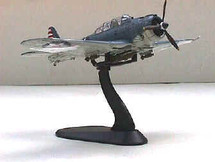
| Merit International 1:18 88002 SBD-3 Dauntless - USS Lexington "Battle of the Coral Sea" (Prebuilt Model) |
|||||
|---|---|---|---|---|---|
| Scale: 1:18 |
Length: 22.25" |
Width: 27.75" |
Composition: Plastic |
SKU: MIL-88002 |
Period: World War II |

**ONLY ONE LEFT! THIS ITEM IS NO LONGER IN PRODUCTION.**
Historical Info: The Douglas SBD Dauntless was a naval dive bomber made by Douglas during World War II. The SBD was the United States Navy's main dive bomber from mid-1940 until late 1943, when it was largely replaced by the SB2C Helldiver. The aircraft was also operated by the United States Army as the A-24 Banshee.
Although relatively slow and outmoded when it began its combat career, it was rugged and dependable and sank more Japanese shipping than any other aircraft during World War II.
U.S. Navy and Marine Corps SBDs saw their first action at Pearl Harbor. A total of 18 SBDs from the carrier USS Enterprise arrived over Pearl Harbor during the Japanese attack, and Scouting Squadron Six (VS-6) lost six aircraft, while Bombing Squadron Six (VB-6) lost one. Most Marine SBDs of Marine Scout Bombing Squadron 232 (VMSB-232) were destroyed on the ground at Ewa Mooring Mast Field. On 10 December 1941, Enterprise SBDs sank the Japanese submarine I-70. In February-March 1942, SBDs from the carriers USS Lexington, Yorktown and Enterprise took part in various strikes on Japanese installations in the Gilbert Islands, Marshall Islands, New Guinea, at Rabaul, on Wake and on Marcus Island.
The type's first major use was in the Battle of the Coral Sea, when SBDs and TBDs sank the Japanese carrier. SBDs were also used as anti-torpedo combat air patrol (CAP) and scored several times against Japanese aircraft trying to attack Lexington and Yorktown.
Their relatively heavy gun armament—two forward firing .50 in (12.7 mm) M2 Browning machine guns and either one or two rear flexible-mount .30 in (7.62 mm) AN/M2 machine guns—was effective against the lightly built Japanese fighters, and many pilot-gunner combinations took an aggressive attitude to fighters which attacked them. One pilot—Stanley "Swede" Vejtasa—was attacked by three Mitsubishi A6M2 Zero fighters but managed to shoot two of them down and cut the wing of the third in a head-on pass with his wing tip.
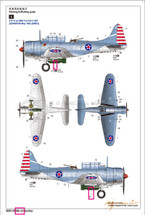
Info: SBD-3 "Dauntless" S. Navy - VS-2 USS Lexington, May 7th, 1942 "Battle of the Coral Sea" (Prebuilt Model)
Main Features:
- Accurate Shape
- Authentic Markings
- Detailed Cockpit and Gunner Station
- Detailed Engine
Moving / Workable Parts List:
- Rudder
- Ailerons
- Dive Flaps
- Elevators
- Arresting Hook
- Main Landing Gears
- Trapeze for Center Bomb
- Rear .30 cal Machine gun
- Rear .30 cal Storage Compartment Doors
- Pilot Canopy, Gunner Canopy and Rear Canopy


Posted by Edward Erdmann on 3rd Aug 2012
Merit International trumpets this 1/18 airplane as upping the ante for 1/18 model quality. I am inclined to agree. This one seems top notch in many ways.
To the best of my limited knowledge, the model is convincingly finished and weathered. At worst it will cause interesting arguments among those who have super-detailed knowledge of this exact airplane.
Like other 1/18 aircraft, this warbird takes some assembly once it is slid out of the box (be patient, the interior box ends fit quite snug) and removed from the plastic supporting structure (use a wire cutters carefully).
The only fit problem was the wing (this happens with other models). To get the wings to meet the wing roots well, take two steps. 1) There are four slots on either side of the center of the wing. Peer at the wing and fuselage where they meet to identify the two slots that correspond to T-shaped flanges on the inside of the fuselage where the wing snugs in place. Then enlarge these slots just a bit (I patiently used a hobby file). Doing so will allow the wing just a bit of back-and-forth wiggle room so it can be aligned with the fuselage.
2) File down the leading edge of the wing center where it will fit into the opening of the fuselage. I file this on an angle, filing deeper to the unfinished inside of the wing, much less to the finished outer surface. Doing so preserves the paint job.
Then fit the wing in place. Take your time and repeat 1) and or 2) as necessary until the wing fits reasonably snug with just a firm but careful rap of the heel of your hand.
As to the weathering: there are lots of silver "chips" and wear spots on the various leading edges of the aircraft as well as along the wing roots where crew members would walk. But the footsteps are pristine. Hmmm... Were the pilot and gunner so careful. Wait! Where are the pilot and gunner? Did they bail out? One will have to find and buy them separately.